
The Inner Law of Your Being — The I Ching on Perseverance
Perseverance is the most repeated counsel in the Book and the most misread. Wilhelm's word means correct and firm: not teeth gritted against resistance, but holding fast to your own grain until it emerges.
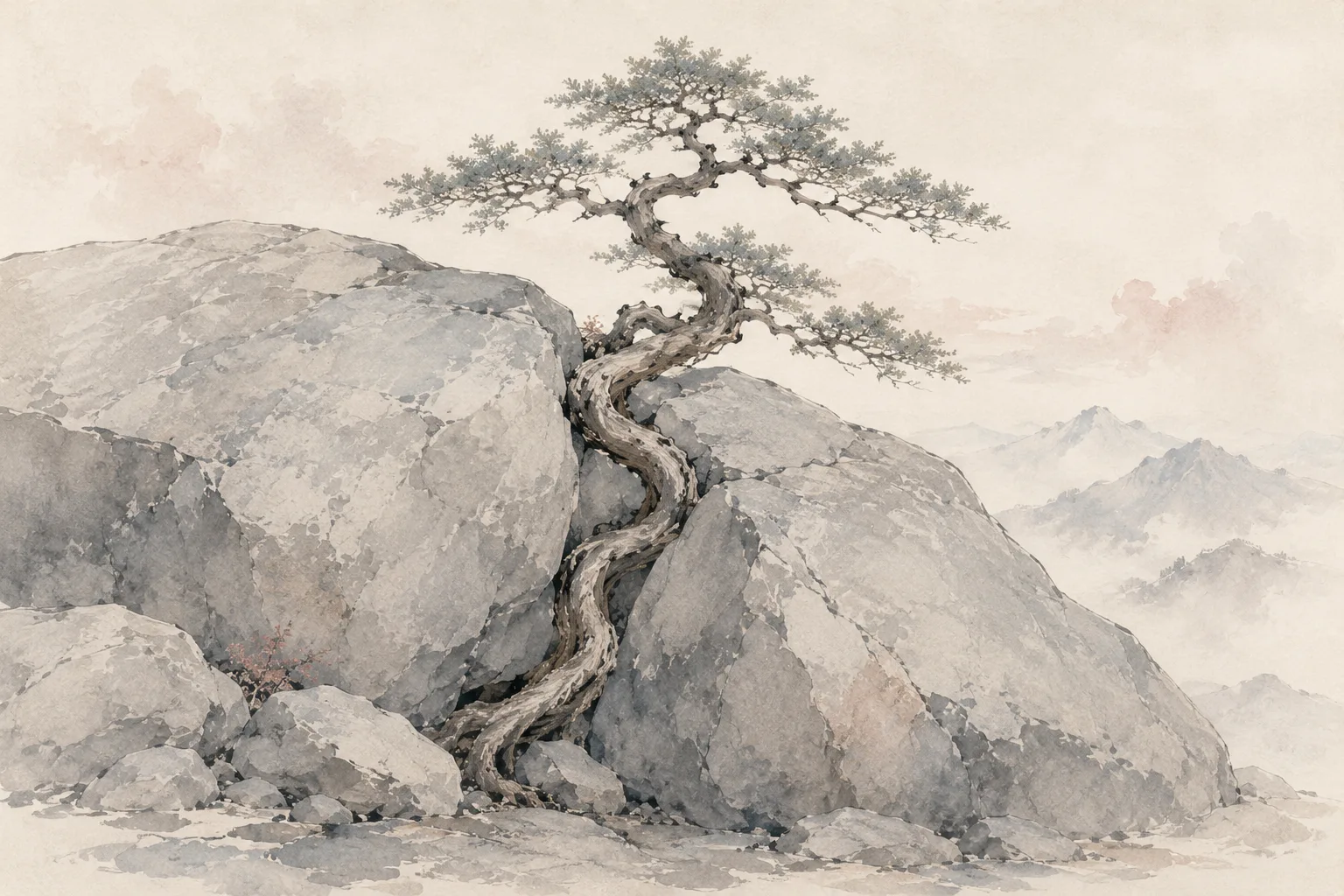
Perseverance furthers. It is the most repeated counsel in the I Ching — and the most misread. We hear “perseverance” and think of teeth gritted against resistance, endurance for its own sake. Wilhelm points somewhere else. The word, he tells us, means literally “correct and firm.” To persevere is not to outlast the storm through sheer will. It is to stay true to what you are.
This becomes clear the moment you ask what perseverance is for. In the opening hexagram, The Creative, the four powers of heaven are defined, and the third — “furthering” — is glossed as “creating that which accords with the nature of a given being.” The Creative is not a force that imposes a shape from outside. It draws each thing toward the shape already latent in it: “The course of the Creative alters and shapes beings until each attains its true, specific nature, then it keeps them in conformity with the Great Harmony. Thus does it show itself to further through perseverance.”
Read that again. To further is to help a thing become what it was made to be. And perseverance is the discipline that carries it there. Your becoming is not a matter of adding to yourself, but of holding fast to your own grain until it fully emerges.
Hexagram 32, Duration, says what actually endures. Not rigidity — the enduring man “always keeps abreast of the time and changes with it.” What holds constant is deeper than circumstance: “What endures is the unswerving directive, the inner law of his being, which determines all his actions.” The world changes; you keep your direction. That is perseverance.
The I Ching trusts that this inner law is good. Hexagram 25, Innocence, puts it plainly: “Man has received from heaven a nature innately good, to guide him in all his movements. By devotion to this divine spirit within himself, he attains an unsullied innocence.” But it adds a warning — the reason perseverance is required at all. “If someone is not as he should be, he has misfortune.” The failure is not weakness. It is becoming someone other than who you are.
Water is the model, as ever. Meeting every obstacle, filling every low place, “nothing can make it lose its own essential nature. It remains true to itself under all conditions.”
To persevere is not to force. It is to refuse to become anything other than yourself — until the time fulfills what you already are.